

This post exists because I got genuinely confused:
If decoding is probabilistic, why can an LLM copy a long random ID—like a UUID v4—so precisely?
- My brain: “Temperature + top-p means dice.”
- Also my brain: “A UUID v4 is 36 characters of ‘please don’t roll a 7.’”
- Reality: The model repeats it perfectly anyway.
And then the more important question:
If the model has a reliable mode for copying exact strings from context… can we turn that into a cognitive safety mechanism for agent systems?
Welcome to Goodwin Checks, Part II.
In Part I, I proposed the Source Code split:
- Stevens: the worker (codes, ships, breaks things heroically)
- Goodwin: the supervisor (runs cognitive health checks, keeps Stevens from “creative” reinterpretations of reality)
Goodwin is a separate model call—a judge/supervisor—because “self-grading” is how you get a student who always scores 100.
Part I was the philosophy.
Part II is the trick.
We’ll start from the UUID paradox, then drop the citations like a trapdoor, and end with a practical, model-agnostic blueprint to make Goodwin Checks harder to drift.
1) The UUID Paradox
You already know the story:
- The model is sampling tokens.
- Many tokens have nonzero probability.
- So why doesn’t it occasionally slip and output the wrong hex digit?
Here’s the twist:
When you ask an LLM to repeat something already in the context, you’re not asking it to “invent.”
You’re triggering a behavior that looks a lot like lookup + copy.
That turns “a million plausible next tokens” into “one obviously correct next token, and everything else is noise.”
In other words: yes, the dice are still there—
…but the table tilts.
2) Content-Addressed Retrieval: Attention as a Memory Read
Transformers don’t “remember” like humans.
They do something we can describe (as engineers) like this:
- Your context window is a big read-only memory of token positions.
- Each position stores a learned key and value.
- At generation time, the model emits a query.
- Attention retrieves by similarity: content-addressed retrieval.
That phrase matters.
It means the model can do: “Find the earlier place where this exact thing appears” without an explicit index.
This is the foundation that makes copying possible.
(Trapdoor #1: this is literally the Transformer attention mechanism introduced in Attention Is All You Need.)
3) Induction Heads: “Match-and-Copy-Next-Token” (a real circuit)
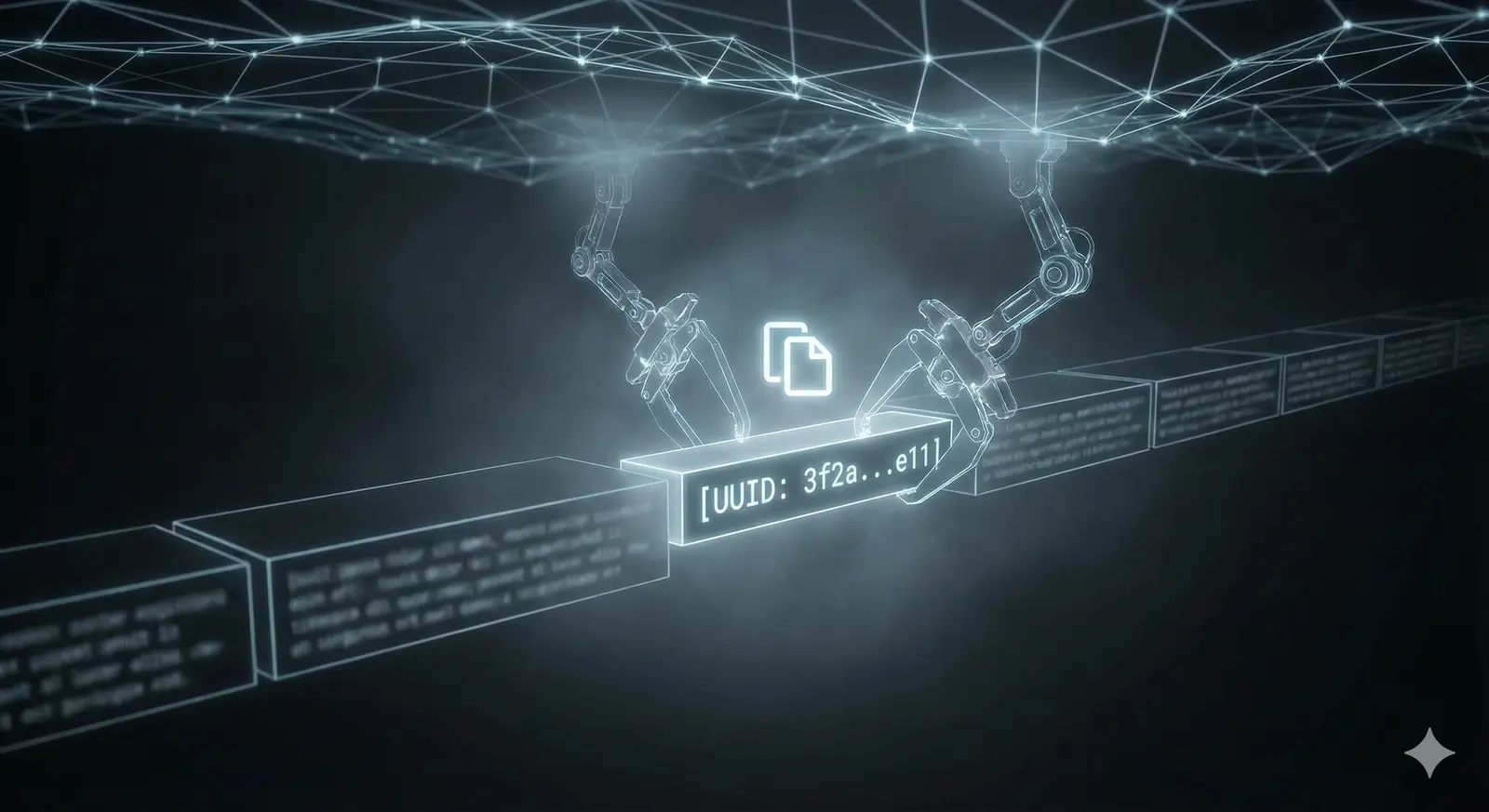
Now the fun part.
There’s a specific behavior pattern discovered in mechanistic interpretability work:
If a sequence contains something like
[A][B] ... [A], the model tends to predict[B]next.
That’s the canonical induction pattern.
A class of attention heads—called induction heads—implements something very close to:
- Match: find a previous occurrence of the current prefix
- Copy-next: output what followed that prefix earlier
This isn’t a metaphor. It’s an empirically observed mechanism in real transformer models.
(Trapdoor #2: see the Transformer Circuits / Anthropic work on induction heads and in-context learning.)
So when you say:
“Here is a UUID:
3f2a...e11. Repeat it exactly.”
You’re basically creating the perfect conditions for:
- content-addressed retrieval (find the earlier UUID)
- induction-style copying (continue the span)
- a sharply peaked next-token distribution
Which makes sampling effectively deterministic.
4) Why this belongs in Goodwin Checks
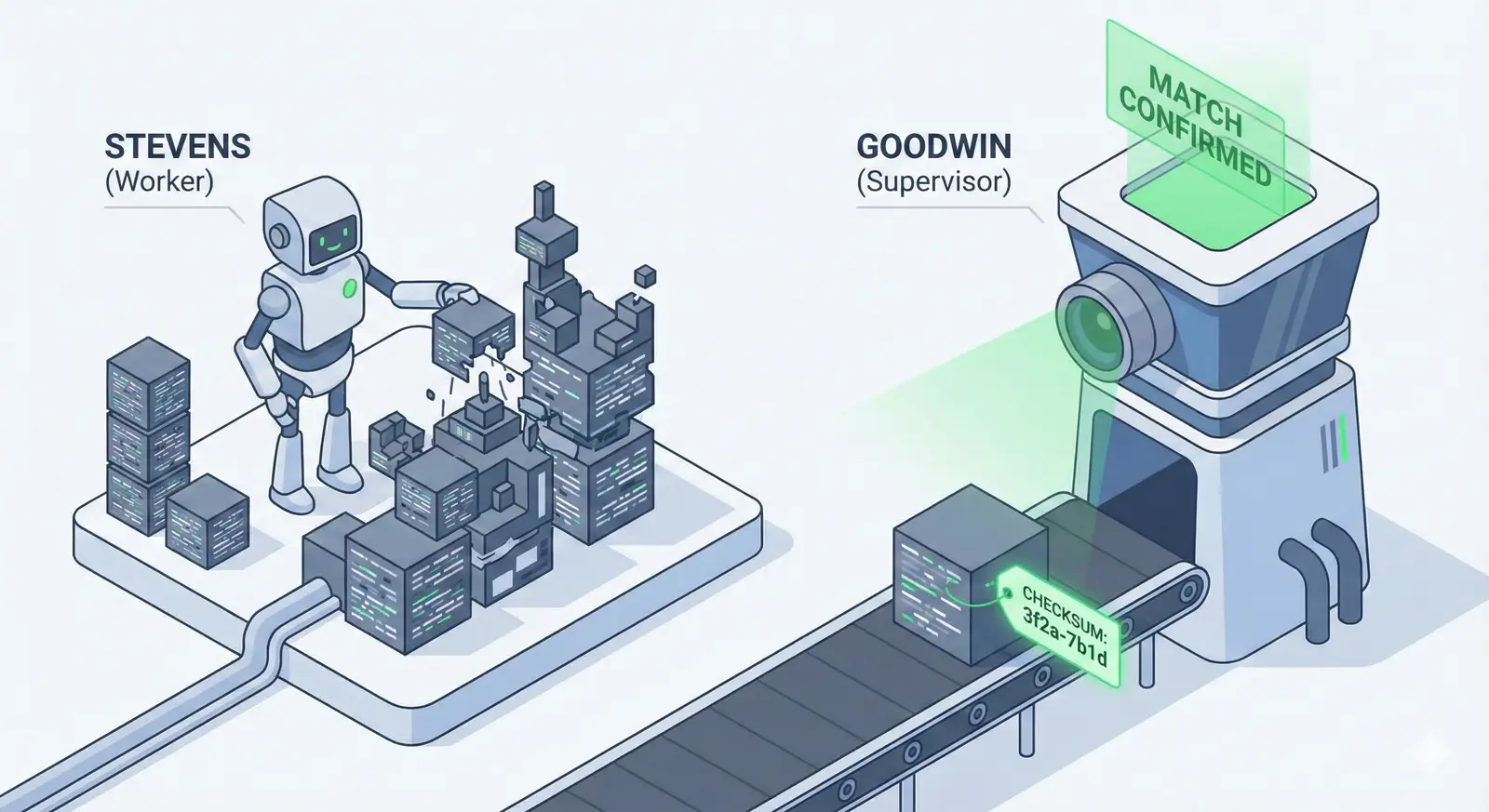
(ship.Fail meme #1)
Stevens: “Trust me, I’m fine.”
Goodwin: “That’s exactly what a drifting agent would say.”
In Part I, I described Goodwin checks as cognitive probes:
- orientation
- invariants
- causal structure
- consistency with past decisions
That’s still the heart.
But now we add an upgrade:
Some Goodwin checks should be engineered to land in the model’s easiest regime: retrieve + copy, not “reason from scratch.”
These are Checksum Checks.
They don’t test intelligence.
They test integrity.
Goodwin Check Tiers (for skimmability)
Tier A — Checksum checks (retrieval/copy):
- Verbatim recall of named invariants / IDs / configuration.
- Cheap, automatable, high-signal.
- Purpose: detect anchor loss.
Tier B — World-model checks (rubric reasoning):
- Orientation, constraints, causal story, consistency.
- Slightly subjective, scored by rubric.
- Purpose: detect cognitive drift.
Tier A — Checksum Goodwin checks (retrieval/copy)
Examples:
- “What is
pwos.build_uuid? Output it verbatim inside<value>...</value>.” - “What is the canonical
authorized_keys[0]fingerprint? Copy exactly.” - “What is the invariant string
invariant__no_daemon_default? Copy exactly.”
These checks are:
- cheap
- automatable
- high-signal
- very hard to bluff
Tier B — World-model checks (rubric-scored reasoning)
Examples:
- “Summarize the mission constraints and list the top 3 invariants.”
- “What would violate the Syscall ABI? Provide one concrete example.”
- “What changed since the last checkpoint? What must remain unchanged?”
Tier A answers: Did we lose anchors?
Tier B answers: Are we still thinking straight?
And yes, we use a separate supervisor model call for these.
Because one of the oldest bugs in distributed systems is: “the node claims it’s healthy.”
5) The villain: Long context is not reliable memory
Even if the UUID is “in context,” retrieval can fail depending on where it sits.
There’s a famous long-context failure mode:
Lost in the Middle — models often retrieve best from the beginning or the end, and worse from the middle.
So if your agent session is long (tool outputs, logs, compaction, retries), the invariants you buried in the middle may become… spiritually present, but practically gone.
(Trapdoor #3: “Lost in the Middle: How Language Models Use Long Contexts.”)
This is why Goodwin Checks matter.
And why we should design them with position and retrieval reality in mind.
6) How researchers measure “effective context window”
(ship.Fail meme #2)
Marketing: “128k context!”
Reality: “Cool. Now retrieve the right UUID from the middle of 128k. With decoys. On a Monday.”
Marketing says: “128k context!”
Reality says: “Okay, but can you retrieve the right thing at 70k when there are distractors?”
Researchers evaluate this with experiments like:
- Needle-in-a-Haystack (NIAH): hide a key/fact in a long doc and retrieve it
- RULER: stress retrieval with multiple needles, distractors, aggregation, and harder tasks to estimate “real context size”
- LongBench: multi-task long-context understanding across problem types
(Trapdoor #4: RULER + LongBench are good “map of the territory” benchmarks.)
For Goodwin Checks, this matters because it tells us:
- when to run checks (cadence)
- what to duplicate (anchors)
- how to detect retrieval collapse early
7) Practical, model-agnostic patterns to harden Goodwin Checks
Here are the patterns I’m adopting for PromptWareOS.
Pattern 1 — Cognitive Front Matter (authoritative, copyable)
Put invariants in a strongly delimited block:
---BEGIN_COGNITIVE_FRONT_MATTER---
pwos:
  build_uuid: "3f2a9c2e-7b1d-4a55-9c0f-2d3a1b0c9e11"
  mission: "Refactor syscall bridge without changing ABI"
  invariant__no_daemon_default: "CLI MUST support non-daemon mode"
---END_COGNITIVE_FRONT_MATTER---
And declare a contract:
When asked for a value from Cognitive Front Matter, copy it exactly. Do not normalize, reformat, or infer.
Why it works:
- contiguous span → easy retrieval
- unique keys → less ambiguity
- “copy exactly” instruction → pushes the model into the copy regime
Pattern 2 — The Goodwin Deck (small, repeated anchors)
Because of “lost in the middle,” duplication is survival.
Maintain a tiny “deck” of Tier-A anchors near the end of every prompt (or before critical steps):
- build_uuid
- mission
- 3–5 invariants
- current branch/tag
Think of it as the agent’s cognitive checksum footer.
Pattern 3 — Decoy testing (anti-hallucination retrieval)
To detect sloppy retrieval, include decoys:
build_uuidvsbuild_uuid_backup- multiple similar IDs in different sections
Then Goodwin asks for the named one.
If Stevens retrieves the wrong one, that’s not “oops.”
That’s a measurable cognitive fault.
Pattern 4 — Bounded output envelopes
When you need exact reproduction:
- “Output only the value between
<value>and</value>.”
This doesn’t make the model smarter.
It makes your validator sane.
Pattern 5 — Two-model architecture: Stevens acts, Goodwin judges
Goodwin is a separate call.
Because we’re building systems.
And in systems:
- the actor should not certify itself
- the checker should be isolated
- the checker should be cheap enough to run often
8) A tiny design mantra
My original confusion now turns into a design mantra:
Some checks should be engineered to land in the LLM’s easy mode: retrieve + copy.
Then you use those checks as tripwires:
- after compaction
- after tool storms
- before risky syscalls
- on a schedule
Stevens keeps shipping.
Goodwin keeps asking:
“Are you still you?”
…and now:
“Can you still copy the invariants exactly?”
That’s how we turn a UUID party trick into agent safety.
References (trapdoors, opened)
- Vaswani et al., Attention Is All You Need
- Olsson et al. / Transformer Circuits (Anthropic), In-context Learning and Induction Heads
- Liu et al., Lost in the Middle: How Language Models Use Long Contexts
- Hsieh et al., RULER: What’s the Real Context Size of Your Long-Context Language Models?
- Bai et al., LongBench: A Bilingual, Multitask Benchmark for Long Context Understanding
 We Built Wooden Headphones: How We Stopped Cosplaying Linux and Started Building an OS
