

If you’ve ever built an event-driven system, you’ve probably experienced that sinking feeling when you realize messages are getting lost. I certainly have. And that frustration is exactly what led me to create the Mailbox library.
In this post, I’ll share the journey of rebuilding Mailbox from XState v4 to v5, but more importantly, I want to help you understand why the Actor Mailbox pattern matters, especially if you’re building cloud-native systems with CQRS and Event-Driven Architecture.
By the end, you’ll understand:
- Why actors without mailboxes are like restaurants without a queue
- How XState v5 transforms state machines into proper actor brains
- Why Mailbox might be the missing piece in your distributed system architecture
Let’s dive in.
My Story: Why I Built Mailbox
Back in 2021, I was building a conversational AI system. We had dozens of “agents” (think chatbots with personalities) that needed to handle messages from users. Each agent was a state machine: they could be idle, thinking, responding, or waiting for external APIs.
The problem was simple: when multiple users sent messages to the same agent simultaneously, things got messy.
User A: "Hello!"        → Agent receives it, starts thinking...
User B: "How are you?"  → Agent is busy... message LOST
User C: "Help me!"      → Agent is still busy... message LOST
I was using XState v4 at the time, which is brilliant for modeling state machines. But XState machines process events immediately. If an event arrives while the machine is in a state that doesn’t handle it, the event simply disappears.
I searched for solutions. In the Erlang and Elixir world, this is a solved problem because every actor has a mailbox by default. In Akka (Scala and Java), same thing. But in the JavaScript ecosystem, nothing.
So I built Mailbox.
The first version was hacky. It worked, but it fought against XState rather than working with it. When XState v5 was announced with first-class actor support, I knew it was time for a complete rewrite.
This is the story of that rewrite.
The Problem: Why Actors Need Mailboxes
The Lost Message Problem
Imagine you’re building a coffee shop ordering system. Each coffee machine is an actor: it receives orders, makes coffee, and serves customers.
sequenceDiagram
    participant A as Customer A
    participant B as Customer B
    participant C as Customer C
    participant M as Coffee Machine

    A->>M: ORDER_COFFEE
    Note over M: Processing A's order...
    B->>M: ORDER_COFFEE
    Note over M: Still busy, B's order LOST
    C->>M: ORDER_COFFEE
    Note over M: Still busy, C's order LOST
    M->>A: COFFEE_READY
Customers B and C are furious. They paid for coffee they’ll never receive. In a real system, this could mean:
- Lost financial transactions
- Corrupted aggregate state
- Angry users or silent data loss
This is the lost message problem, and it happens whenever you have:
- An actor that processes one thing at a time
- Multiple senders that don’t coordinate
- No queue to buffer incoming messages
The Actor Model Refresher
Before we solve this, let’s revisit the Actor Model. Proposed by Carl Hewitt in 1973, it’s a mathematical model for concurrent computation. Every actor:
- Processes one message at a time
- Maintains private state
- Communicates via messages
graph LR
    subgraph "Actor A"
        A_MB[Mailbox] --> A_STATE[State]
    end
    subgraph "Actor B"
        B_MB[Mailbox] --> B_STATE[State]
    end

    External[External World] -->|message| A_MB
    A_STATE -->|message| B_MB
The key insight is that every proper actor implementation includes a mailbox. The mailbox queues incoming messages, and the actor processes them one at a time in order.
Erlang has it. Akka has it. Microsoft Orleans has it.
JavaScript Reality
JavaScript is single-threaded (mostly), which actually makes it great for actors. No need for locks. But the ecosystem never standardized on an actor framework.
XState came along and gave us beautiful state machines. But XState machines aren’t actors in the Hewitt sense because they don’t have mailboxes.
When you send() an event to an XState machine:
- If the machine can handle it in the current state, it’s processed
- If the machine can’t handle it, it’s silently dropped
This is fine for UI state machines. A button click while a modal is open can be ignored. But for backend message processing, it’s a disaster.
The CQRS Connection
If you’re building systems with CQRS (Command Query Responsibility Segregation), this problem is even more critical.
In CQRS, your aggregates receive commands and emit events:
graph LR
    CMD[Commands] --> AGG[Aggregate]
    AGG --> EVT[Events]
    EVT --> READ[Read Model]

    subgraph "Write Side"
        CMD
        AGG
        EVT
    end

    subgraph "Read Side"
        READ
    end
The aggregate must process commands sequentially. Each command might depend on state changes from the previous one:
Command 1: CreateOrder(id=123)        → Order created
Command 2: AddItem(id=123, item=A)    → Item added
Command 3: AddItem(id=123, item=B)    → Another item added
Command 4: SubmitOrder(id=123)        → Order submitted
If Command 2 arrives before Command 1 is processed, you get invalid state. If Command 4 arrives while Command 2 is processing, you can end up skipping items.
This is where Mailbox shines. It ensures your aggregate (actor) processes commands one at a time, in order, without losing any.
Enter XState: State Machines as Actor Brains
Why State Machines for Actors
State machines are a great “brain” for actors because they provide:
- Explicit states
- Defined transitions
- Guards
- Visual representation
stateDiagram-v2
    [*] --> Idle
    Idle --> Processing: WORK
    Processing --> Idle: complete
    Processing --> Error: fail
    Error --> Idle: retry
When you combine state machines with mailboxes, you get predictable behavior (state machine guarantees), reliable delivery (mailbox guarantees), and sequential processing (actor model guarantees).
XState’s Evolution: v4 to v5
XState v4 was revolutionary. It brought proper state machines to JavaScript. But actors were bolted on, not built in.
In v4, you’d “spawn” child machines:
// XState v4
spawn(childMachine, { name: "child" })
XState v5 changed everything. David Khourshid rebuilt XState with the Actor Model at its core:
// XState v5
setup({
  actors: {
    child: childMachine,
  },
}).createMachine({
  invoke: {
    id: "child",
    src: "child",
  },
})
graph TB
    subgraph "XState v4"
        V4_INT[Interpreter] --> V4_MACH[Machine]
        V4_MACH -->|spawn| V4_CHILD[Child]
        V4_CHILD -.->|manual routing| V4_MACH
    end

    subgraph "XState v5"
        V5_ACT[Actor] --> V5_MACH[Machine]
        V5_MACH -->|invoke| V5_CHILD[Child Actor]
        V5_CHILD -->|sendParent| V5_MACH
    end
The key improvements in v5:
createActor()instead ofinterpret()- Native
invokefor child actors with lifecycle management sendParent()for parent child communicationsetup()API for type-safe machine definitions- Inspection API for debugging and event capture
These changes aligned perfectly with what Mailbox needed. The rewrite was inevitable.
The Mailbox Library: Bridging the Gap
What Mailbox Is
Mailbox is a library that wraps any XState machine and gives it proper actor semantics:
graph LR
    EXT[External Senders] -->|events| MB[Mailbox]

    subgraph "Mailbox Wrapper"
        MB --> Q[Queue]
        Q -->|one at a time| CHILD[Child Machine]
        CHILD -->|ACTOR_IDLE| MB
        CHILD -->|ACTOR_REPLY| MB
    end

    MB -->|replies| EXT
Features:
- Message queuing
- Sequential processing
- Reply routing
- Capacity limits
- Observable interface
The Mailbox Protocol
The protocol is intentionally simple. Your child machine only needs to do two things.
sequenceDiagram
    participant S as Sender
    participant M as Mailbox
    participant C as Child Machine

    S->>M: send(EVENT)
    M->>M: Enqueue message
    M->>C: Forward EVENT
    Note over C: Processing
    C->>M: ACTOR_IDLE
    C->>M: ACTOR_REPLY
    M->>S: Forward reply

    Note over M: Dequeue next message
    M->>C: Forward next EVENT
Rule 1: Signal idle.
When your machine is ready for the next message, call Mailbox.actions.idle():
idle: {
  entry: Mailbox.actions.idle("worker"),
  on: {
    WORK: "processing",
  },
},
Rule 2: Reply when done.
Use Mailbox.actions.reply() to send responses:
actions: Mailbox.actions.reply(({ context }) => ({
  type: "DONE",
  result: context.result,
})),
That’s it. Two rules. Your machine doesn’t need to know anything about queuing, routing, or mailbox internals.
Quick Start Example
Here’s a complete example: a worker that processes jobs sequentially.
import * as Mailbox from "mailbox"
import { setup, assign } from "xstate"

const workerMachine = setup({
  types: {} as {
    context: { result: string | null }
    events:
      | { type: "PROCESS"; data: string }
      | { type: "DONE"; result: string }
  },
}).createMachine({
  id: "worker",
  initial: "idle",
  context: { result: null },
  states: {
    idle: {
      entry: Mailbox.actions.idle("worker"),
      on: {
        PROCESS: "working",
      },
    },
    working: {
      entry: assign({
        result: ({ event }) => `Processed: ${event.data}`,
      }),
      after: {
        100: {
          target: "idle",
          actions: Mailbox.actions.reply(({ context }) => ({
            type: "DONE",
            result: context.result!,
          })),
        },
      },
    },
  },
})

const mailbox = Mailbox.from(workerMachine)

mailbox.subscribe({
  next: (event) => console.log("Reply:", event),
})

mailbox.open()
mailbox.send({ type: "PROCESS", data: "Job 1" })
mailbox.send({ type: "PROCESS", data: "Job 2" })
mailbox.send({ type: "PROCESS", data: "Job 3" })
All three jobs are processed sequentially, no messages lost, replies in order.
The Migration Journey: v4 to v5

The Old Architecture (v4)
The original Mailbox was complex.
graph TB
    subgraph "Mailbox v4"
        WRAP[wrap.ts] --> DUCK[duckularize.ts]
        DUCK --> CTX[Context Utilities]

        subgraph "Context Utils"
            CTX --> ENQ[enqueue.ts]
            CTX --> DEQ[dequeue.ts]
            CTX --> ORIG[origin tracking]
            CTX --> SIZE[size.ts]
        end

        WRAP --> COMPAT[xstate-compat.ts]
        COMPAT -->|shim| XSTATE[XState v4]
    end

    style COMPAT fill:#f99,stroke:#333
The xstate-compat.ts shim was the worst part. XState v4’s spawn() had quirks that required workarounds.
Total: 50+ files and 7000+ lines of code.
The New Architecture (v5)
XState v5’s native actor support meant we could throw most of that away.
graph TB
    subgraph "Mailbox v5"
        MAILBOX[mailbox.ts\n500 lines]

        MAILBOX --> FROM[from]
        MAILBOX --> ACTIONS[actions.idle\nactions.reply]
        MAILBOX --> IMPL[MailboxImpl class]

        IMPL --> INVOKE[invoke child]
        IMPL --> SEND[sendParent]
        IMPL --> INSPECT[inspection API]
    end

    style MAILBOX fill:#9f9,stroke:#333
One main file. Around 500 lines. Everything else deleted.
What Changed Technically
| Aspect | v4 Approach | v5 Approach |
|---|---|---|
| Child actor | spawn() + compat shim |
Native invoke |
| Parent communication | Custom event routing | sendParent() |
| Event capture | Manual subscription | Inspection API |
| Type safety | duckularize() helper |
Native setup() |
| Queue management | 6 custom context files | Simple array |
| Lines of code | 7000+ | ~500 |
The v5 approach is cleaner because we’re working with XState, not against it.
The Challenges We Hit
It wasn’t all smooth sailing.
- TypeScript limitations with
enqueueActions. - The
Clocktype no longer exported. - Stricter typing in XState v5 patch releases.
- Cross-platform line endings.
These are the kinds of “migration cuts” you only discover by rebuilding and re-running tests repeatedly.
My AI Co-Founder
I have a confession: I didn’t do this migration alone.
Most of the heavy lifting was done by Claude, my AI co-founder. Here are the stats:
134 files changed
3,322 insertions(+)
6,957 deletions(-)
How did we work together:
- I provided the vision.
- Claude explored the codebase.
- We iterated on architecture.
- Claude wrote the code.
- I reviewed and directed.
- Claude debugged issues.
The process felt like pair programming with a partner who never gets tired.
Lessons Learned: Best Practices
When to Use Mailbox
flowchart TD
    START[Do you need sequential message processing] -->|Yes| Q2[Is ordering important]
    START -->|No| PLAIN[Use plain XState]

    Q2 -->|Yes| Q3[Do senders expect replies]
    Q2 -->|No| PLAIN

    Q3 -->|Yes| MAILBOX[Use Mailbox]
    Q3 -->|No| Q4[Is message loss acceptable]

    Q4 -->|No| MAILBOX
    Q4 -->|Yes| PLAIN

    style MAILBOX fill:#9f9,stroke:#333
Use Mailbox when:
- Processing commands in CQRS aggregates
- Handling user requests that must be sequential
- Building workflow engines
- Managing resource access (one request at a time)
Use plain XState when:
- UI state management
- Form validation
- Navigation state
- Parallel processing is desired
Mailbox in CQRS Architecture
graph TB
    subgraph "External"
        API[API Gateway]
        MQ[Message Queue\nKafka or RabbitMQ]
    end

    subgraph "Actor System\nNode.js"
        API --> ROUTER[Command Router]
        MQ --> ROUTER

        ROUTER --> MB1[Mailbox\nOrder Aggregate]
        ROUTER --> MB2[Mailbox\nUser Aggregate]
        ROUTER --> MB3[Mailbox\nInventory Aggregate]

        MB1 --> SM1[State Machine]
        MB2 --> SM2[State Machine]
        MB3 --> SM3[State Machine]
    end

    subgraph "Persistence"
        SM1 --> ES[Event Store]
        SM2 --> ES
        SM3 --> ES
    end

    ES --> PROJ[Projections]
    PROJ --> READ[Read Models]
Each aggregate receives commands via its Mailbox, processes them sequentially, emits events to the Event Store, then signals readiness for the next command.
Design Principles I Learned
- Keep the protocol simple.
- Let the state machine do the heavy lifting.
- Embrace observables.
Looking Forward
XState’s Trajectory
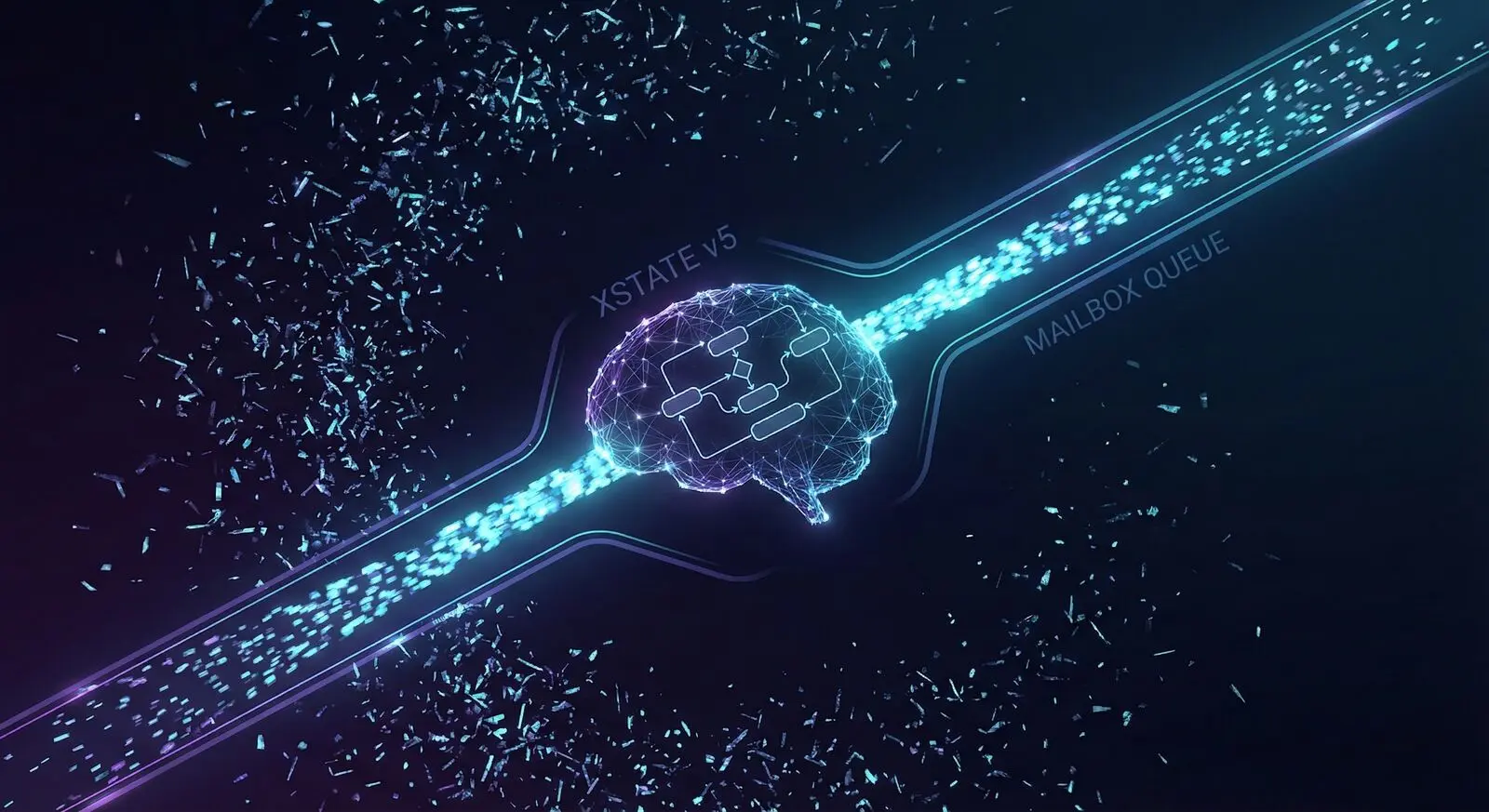
XState is becoming more than a state machine library.
- Stately.ai
@xstate/graph@statelyai/inspect
Mailbox’s Future
Ideas I’m exploring:
- Distributed mailboxes
- Persistence
- Cloud queue integration
- Metrics
The Bigger Picture
The cloud-native, event-driven, CQRS style architecture common in JVM and Erlang worlds is now achievable in Node.js.
Key Takeaways
graph LR
    subgraph "The Three Pillars"
        A[Actor Pattern\nNeeds Mailbox]
        B[XState v5\nActor Brain]
        C[Cloud-Native\nEDA and CQRS]
    end

    A --> D[Mailbox Library]
    B --> D
    C --> D

    D --> E[Production-Ready\nActor System]

    style D fill:#9f9,stroke:#333
    style E fill:#ff9,stroke:#333
- Actor pattern needs a mailbox.
- XState is a great actor brain.
- Think cloud-native.
Try It Yourself
npm install mailbox xstate
import * as Mailbox from "mailbox"
import { setup } from "xstate"

const myMachine = setup({
  // your machine definition
}).createMachine({
  // ...
  states: {
    idle: {
      entry: Mailbox.actions.idle("my-actor"),
      // ...
    },
  },
})

const mailbox = Mailbox.from(myMachine)
mailbox.open()
mailbox.send({ type: "YOUR_EVENT" })
Check out the GitHub repository at https://github.com/huan/mailbox for more examples.
Final Thoughts
Building Mailbox has been a journey. From hacky v4 workarounds to clean v5 native code, the library evolved alongside XState itself.
But the core insight remains the same: actors need mailboxes.
If you’re building event-driven systems in TypeScript, I hope Mailbox helps you avoid the lost message pain I experienced.
Happy coding, and may your messages never be lost.
— Huan LI
Have questions or feedback. Open an issue at https://github.com/huan/mailbox/issues or find me on Twitter at https://twitter.com/huan2027.
Pull Request at https://github.com/huan/mailbox/pull/12
This post was written with significant assistance from Claude (Anthropic), my AI co-founder for this refactoring project. The future of open source is collaborative: humans and AI working together.
 Why LLMs Can Copy UUIDs (and How That Makes Agents Safer)